


Training Program
How to Design an Effective Youth Sports Training Program From Scratch: Designing a physical preparation regimen for young athletes requires a fundamentally different approach than training adults. For youth athletes, the primary goals are to build a broad athletic foundation, foster a lifelong love for physical activity, and minimize the risk of injury. Rushing into specialized, high-intensity adult regimens too early often leads to chronic burnout, overuse injuries, and a premature drop in athletic performance.
To build a sustainable framework that balances physical progression with emotional engagement, this guide breaks down how to design an effective youth sports training program from scratch.
1. Prioritize Long-Term Athletic Development (LTAD)
Before introducing sport-specific drills, a successful youth program must focus on building general motor skills. This concept, known as Long-Term Athletic Development (LTAD), emphasizes that general athleticism must precede sports specialization.
- Ages 6–9 (The Fundamentals Phase): Focus almost entirely on fundamental movement skills. Children should learn how to properly run, jump, land, skip, throw, and catch through structured play and multi-sport activities.
- Ages 10–13 (The Learning to Train Phase): Introduce basic coordination and agility drills. This is the optimal window to teach foundational sports techniques and proper bodyweight mechanics without heavy external weights.
2. Structure a Balanced 60-Minute Session
An effective youth session should be tightly organized, fast-paced, and engaging to keep young minds focused. Split a standard 60-minute session into four distinct blocks:
Phase 1: Dynamic Warm-Up and Physical Literacy (10 Minutes)
Never skip the warm-up, but do not make it boring. Use dynamic movements like high knees, butt kicks, bear crawls, and lateral shuffles. Incorporating fun coordination games, such as tag variants, wakes up the nervous system and improves spatial awareness while keeping energy levels high.
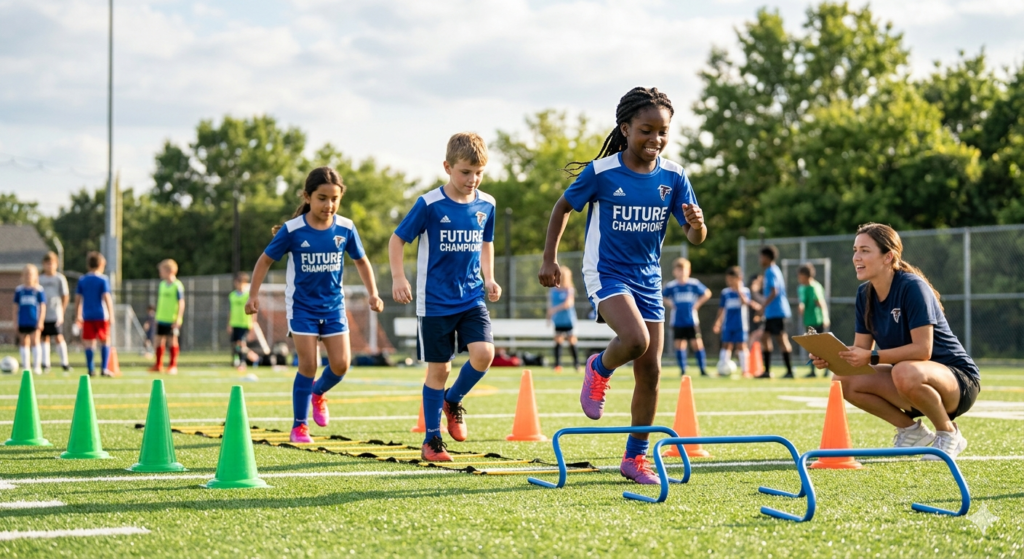
Phase 2: Agility, Speed, and Coordination (15 Minutes)
Train speed and directional changes while the athletes are completely fresh. Use ladder drills, short cone-shuffling patterns, and reactive acceleration drills (e.g., sprinting on a whistle command). Keep reps short (under 5 seconds) and provide full rest between sets to prioritize maximum quality over fatigue.
Phase 3: Strength and Core Stability (20 Minutes)
Youth strength training should focus entirely on movement quality and control. Utilize bodyweight exercises and light resistance tools like medicine balls or resistance bands. Focus on foundational human movements:
- Squats: Bodyweight squats or goblet squats holding a light medicine ball.
- Pushes/Pulls: Modified push-ups, planks, and inverted bodyweight rows.
- Hinges: Teaching proper hip-hinge mechanics using a PVC pipe to protect the lower back.
Phase 4: Condition-Based Games and Cool Down (15 Minutes)
Instead of forcing young athletes to run boring laps for conditioning, use small-sided, high-energy games. Modified scrimmages, relay races, or obstacle courses provide excellent cardiovascular conditioning while reinforcing teamwork and strategic thinking. Conclude with a few minutes of light static stretching.
3. Manage Training Volume and Prevent Burnout
Overuse injuries are skyrocketing in youth sports due to year-round specialization. When structuring your calendar, ensure athletes have at least one to two full days of rest per week. A good rule of thumb is that a child should not participate in organized sports for more hours per week than their age (e.g., a 10-year-old should not exceed 10 hours of structured training per week across all sports).
The Bottom Line
Building an elite athlete does not happen overnight. By focusing heavily on movement quality, physical literacy, and engaging progression metrics, you create an environment where children can thrive safely. Implementing the steps on how to design an effective youth sports training program from scratch will ensure your athletes build an unbreakable physical foundation, avoid injury, and stay excited to step onto the field session after session.